FREE SHIPPING FOR ALL ORDERS IN THAILAND
Best Dive Center Rental Equipment: How to Build a Reliable and Cost-Efficient Rental Fleet
Choosing equipment for a dive center is very different from choosing scuba gear for an individual diver.
A recreational diver may use a regulator or BCD a few dozen times per year. In a busy dive center, the same equipment can be used almost every day by different divers, transported on boats, exposed continuously to salt water and sun, and handled by students with very different levels of experience.
For this reason, the best dive center rental equipment is not necessarily the most expensive or technically advanced equipment.
A successful rental fleet should be durable, simple to operate, easy to maintain and cost-effective throughout its working life.
Whether you operate a dive school, resort, liveaboard or high-volume dive center, here are the most important factors to consider when building or upgrading your rental fleet.
1. Think About Cost Per Dive, Not Just Purchase Price
Purchase price is important, especially when buying 10, 20 or 50 complete scuba sets. However, it should not be the only consideration.
The real cost of rental equipment includes:
- Initial purchase price
- Expected lifespan
- Servicing frequency and cost
- Spare-parts availability
- Repair time
- Staff time required for maintenance
- Equipment downtime
- Replacement components
- Resale or residual value
A regulator that costs slightly more but remains operational longer and can be serviced quickly may ultimately cost less per dive than a cheaper alternative.
The same principle applies to BCDs, wetsuits, fins and other rental equipment.
For professional operators, total cost of ownership is usually a more useful measurement than purchase price alone.
2. Rental Regulators: Keep Them Simple and Reliable
Regulators are among the most important components of any dive center rental fleet.
For warm-water recreational diving and training, a straightforward regulator design can have significant advantages.
A good rental regulator should offer:
- Reliable breathing performance
- Simple operation
- Robust construction
- Easy servicing
- Good spare-parts availability
- Reasonable servicing costs
- Easy hose and component replacement
Rental divers generally do not need multiple adjustment controls or complex features. Simplicity can make equipment easier for students to understand while reducing potential maintenance points.
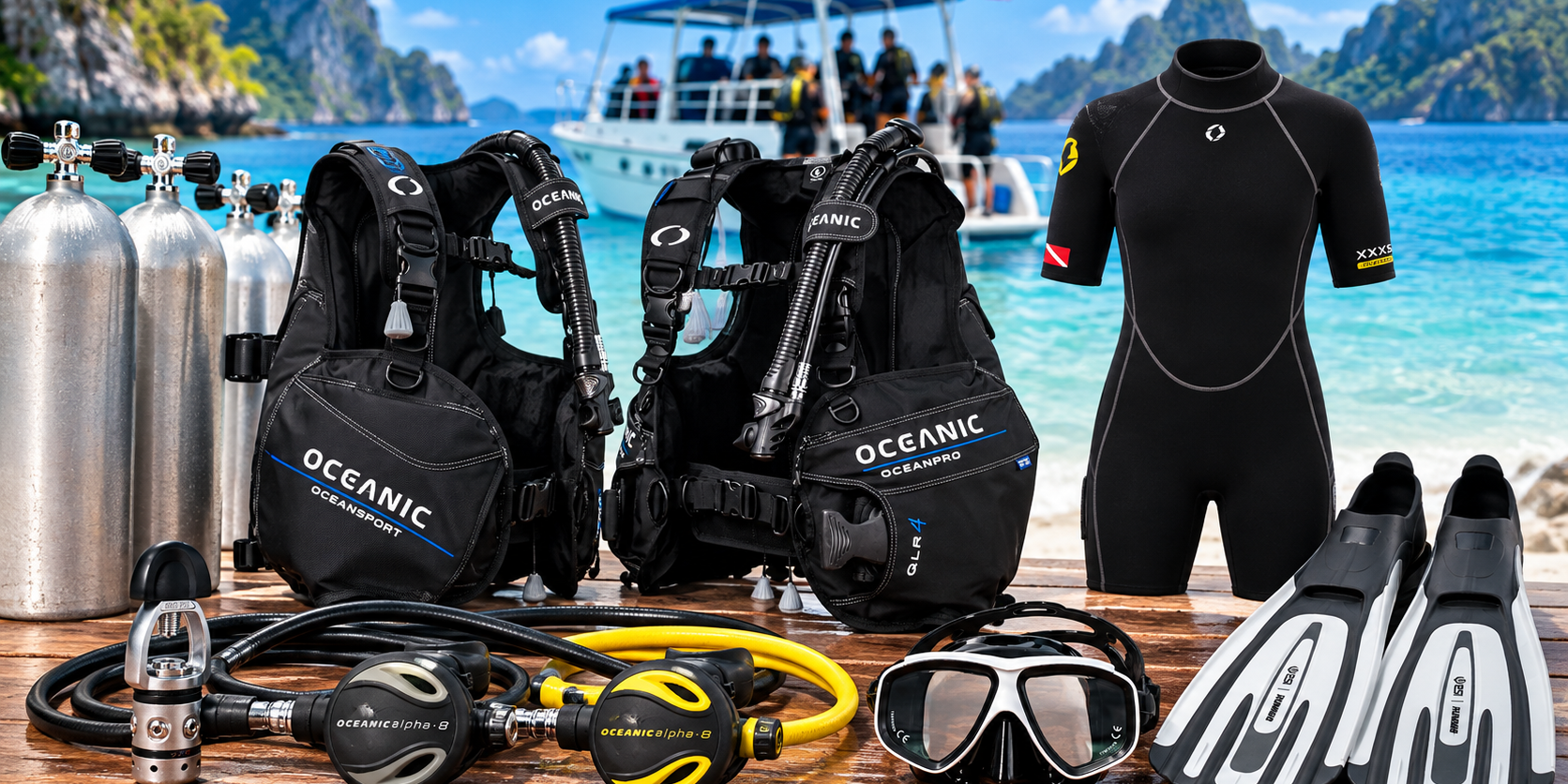
Our Recommendation: Oceanic Alpha 8
The Oceanic Alpha 8 is particularly well suited to dive schools and rental fleets.
Its straightforward design provides the characteristics professional operators need: reliability, ease of use and practical servicing without unnecessary complexity.
For dive centers purchasing multiple regulator sets, standardizing the fleet around one regulator platform also has major operational advantages.
Technicians become familiar with one system, fewer types of service parts need to be stocked, and regulators can be rotated through servicing more efficiently.
A complete rental regulator configuration can combine the Alpha 8 first and second stage with an Oceanic Alpha 8 Octopus and a simple, durable pressure gauge.
3. BCDs: Durability Should Come Before Features
Rental BCDs have a difficult life.
They are repeatedly inflated and deflated, dragged across boat decks, exposed to UV, stored wet and adjusted several times every day.
For rental operations, complicated BCDs with numerous accessories are rarely necessary.
Instead, look for:
- Durable outer materials
- Reinforced high-wear areas
- Simple adjustment
- Reliable buckles
- Easily replaceable components
- Clearly identifiable sizes
- Comfortable fit across different body shapes
Oceanic OceanSport: A Practical Rental Solution
The Oceanic OceanSport BCD is a strong option for high-volume rental and training operations where durability, simplicity and cost control are priorities.
Its straightforward jacket-style configuration makes it easy for students and recreational divers to understand and allows instructors to quickly check equipment before entering the water.
Oceanic OceanPro: A Step Up in Rental BCD
For dive centers looking for a more premium rental solution, the Oceanic OceanPro BCD offers another option while retaining the practical characteristics required for regular professional use.
The choice between OceanSport and OceanPro should depend on your operation, customer profile, expected utilization and target investment per rental set.
4. Standardize Your Rental Fleet
One of the most effective ways to reduce operating costs is often overlooked: standardization.
Using the same regulator, BCD families, gauges and other components across your rental inventory makes day-to-day operations considerably easier.
A standardized fleet can mean:
- Fewer spare parts to stock
- Faster servicing
- Easier troubleshooting
- Simpler staff training
- Faster equipment preparation
- Easier replacement planning
- Greater interchangeability between rental sets
Instead of purchasing equipment solely according to whichever product is cheapest at the time, consider developing a long-term equipment platform for your dive center.
Fleet consistency can save considerable time and money over several years.
5. Rental Wetsuits: Choose the Right Protection for Your Operation
Rental wetsuits experience much more intensive use than privately owned suits. Constant stretching, repeated washing and drying, exposure to sunlight and frequent use of zippers can quickly reveal the difference between a recreational wetsuit and one selected for commercial use.
For warm-water dive centers, particularly in tropical destinations such as Thailand, a 3 mm shorty wetsuit is often the most practical rental solution.
PSI Colby 3 mm Shorty: Our Main Rental Recommendation
The PSI Colby 3 mm Shorty is one of our most popular choices for dive center rental fleets.
For warm-water diving, a shorty provides a good balance between thermal protection, comfort, durability and ease of use. It is particularly suitable for Discover Scuba Diving programs, entry-level courses, snorkeling activities and recreational rental customers.
A shorty also offers several operational advantages for busy dive centers:
- Quick and easy for customers to put on and remove
- Comfortable in tropical water temperatures
- Fewer sizing and fitting issues
- Faster washing and drying between uses
- Compact storage requirements
- Good durability for frequent rental use
- Cost-effective for larger rental fleets
These characteristics make the Colby 3 mm Shorty an excellent workhorse for tropical dive centers where equipment may be used several times per week or even several times per day.
PSI Colby 3 mm Jumpsuit: More Protection When Required
A full-length PSI Colby 3 mm Jumpsuit is a better choice when additional thermal and physical protection is required.
The full suit provides coverage for the arms and legs, offering better protection against cooler water, wind between dives, accidental contact with marine life and minor abrasions during entries, exits and training exercises.
For many dive centers, the best solution is therefore not necessarily choosing between shorties and full suits, but maintaining a rental fleet with 3 mm shorties as the primary option and a selection of 3 mm full suits for customers who need additional protection.
When selecting rental wetsuits, operators should look for durable neoprene, strong stitching, reliable zippers, clearly identifiable sizing and materials capable of handling repeated commercial use.
6. Fins: Durability and Size Management Matter
Rental fins should be simple, robust and easy to organize.
For warm-water operations where divers commonly dive barefoot, full-foot fins can provide a very cost-effective solution.
For operations using dive boots, shore diving or more demanding conditions, open-heel fins may be preferable.
An important consideration is the number of sizes required.
A fin range that accommodates a broad range of foot sizes with fewer individual sizes can reduce the total inventory a dive center needs to carry.
For rental fleets, also consider how easily straps and buckles can be replaced. Losing an entire fin because of one damaged component is unnecessarily expensive.
7. Masks: Fit Is More Important Than Price
Masks are relatively inexpensive compared with regulators and BCDs, but a badly fitting mask can ruin a customer’s dive.
A rental fleet should therefore include masks capable of fitting different face shapes.
Look for:
- Tempered glass
- Quality silicone skirts
- Durable buckles
- Easily adjustable straps
- A selection of different fits
A combination of models such as the PSI Adventure II and PSI Vera masks can help a dive center accommodate different facial profiles rather than relying on a single mask design for every customer.
8. Don’t Forget Cylinders and Valves
Cylinders represent a major part of a dive center’s infrastructure and should be considered as part of the overall rental system rather than separately.
When building a cylinder fleet, consider:
- Cylinder capacity
- Aluminum versus steel
- Working pressure
- Valve configuration
- DIN/Yoke compatibility
- Local inspection requirements
- Replacement valve and O-ring availability
- Nitrox requirements
Standardizing cylinders and valves can simplify filling procedures, maintenance and staff training.
Dive centers should also maintain clear inspection and maintenance records for their cylinder fleet.
Check our reliable and competitive Scuba Cylinders.
9. The Compressor Is the Heart of the Operation
A busy dive center can own excellent rental equipment, but without a reliable supply of breathing air, the operation stops.
Choosing the correct compressor therefore requires more than comparing purchase prices.
Consider:
- Number of cylinders filled per day
- Required filling capacity
- Peak filling periods
- Available electrical supply
- Petrol or electric operation
- Ventilation
- Noise
- Filtration
- Maintenance requirements
- Availability of filters, oil and spare parts
- Local technical support
A small operation and a dive center filling dozens of cylinders every afternoon have very different compressor requirements.
Professional compressor systems such as Nardi Compressori are available in different capacities, allowing the compressor to be matched to the actual workload of the dive operation.
The objective should be sufficient capacity without unnecessarily oversizing the system.
10. Spare Parts, Local Service Support and Technical Training Are Critical
A piece of rental equipment only generates revenue while it is available for use.
For this reason, after-sales service should be considered from the beginning when selecting equipment for a rental fleet.
Before investing in a large quantity of equipment, ask:
- Are service kits readily available?
- Are replacement parts stocked locally?
- Are trained technicians available?
- How quickly can equipment be repaired?
- Can the dive center stock common replacement parts?
- Is technical training available for our own technicians?
Saving a small amount on the original equipment purchase can quickly become expensive if a BCD or regulator remains out of service while waiting for parts or external servicing.
For commercial operators, equipment uptime has real financial value.
Train Your Own Dive Center Technicians
For larger dive centers, developing the technical capabilities of your own staff can significantly improve rental fleet management.
Aquamaster provides technical service training for dive center technicians, helping them develop the knowledge required to correctly inspect, maintain and service supported equipment.
Technical training can help a dive center:
- Identify problems before equipment fails
- Perform routine preventive maintenance correctly
- Reduce unnecessary equipment downtime
- Improve troubleshooting
- Optimize service intervals
- Better manage spare-parts inventory
- Extend the working life of rental equipment
- Maintain a more consistent and reliable rental fleet
The objective is not simply to repair equipment when something goes wrong. A good maintenance program should be preventive rather than reactive.
Combining standardized rental equipment, access to genuine spare parts, local technical support and properly trained technicians can significantly improve the efficiency of a dive center’s maintenance operation.
When planning a new rental fleet, it is therefore worth considering the complete support package: equipment + spare parts + servicing + technical training.
11. Consider Custom-Branded Rental Equipment
Rental equipment can also become part of a dive center’s branding.
Wetsuits, gear bags and selected accessories can be customized with a dive center logo, helping create a more professional and consistent appearance.
This can be particularly valuable for resorts, liveaboards and larger dive schools where customers frequently photograph themselves using the equipment.
Custom branding can turn equipment that you already need into another opportunity to reinforce your dive center’s identity.
12. How Many Rental Sets Does a Dive Center Need?
There is no universal answer.
The correct fleet size depends on your maximum number of divers, average utilization, customer size distribution and how quickly equipment can be serviced or replaced.
However, operators should avoid calculating their requirements solely around the average number of customers.
A practical rental fleet should include enough redundancy to cover:
- Peak operating periods
- Equipment undergoing servicing
- Unexpected repairs
- Unusual customer sizes
- Last-minute bookings
For critical components such as regulators and BCDs, keeping spare operational units can prevent a minor equipment issue from affecting a customer’s dive or delaying an entire boat.
Build Your Rental Fleet as a System
The best dive center rental equipment is not simply a collection of inexpensive regulators, BCDs and wetsuits.
It is a complete operational system.
Regulators, BCDs, exposure protection, masks, fins, cylinders, compressors, spare parts and servicing should work together to maximize equipment availability while controlling the cost of every dive.
A well-planned rental fleet should therefore focus on four principles:
Durability. Standardization. Serviceability. Cost per dive.
At Aquamaster, we have been supplying diving equipment in Thailand since 1997 and work with dive centers, resorts, liveaboards and professional operators throughout the country.
Our Dive Center Rental Equipment solutions include Oceanic regulators and BCDs, PSI ProDive rental equipment, cylinders, valves, accessories and Nardi compressors, supported by professional servicing, spare parts and technical expertise.
Whether you are opening a new dive center, replacing an aging rental fleet or upgrading part of your operation, our team can help you select the right equipment configuration for your number of divers, operating conditions and budget.
Explore our Dive Center Rental Equipment & Scuba Rental Gear or contact Aquamaster to discuss a customized rental fleet package.