FREE SHIPPING FOR ALL ORDERS IN THAILAND
How to Choose a Scuba Diving BCD | Complete Guide
A BCD (Buoyancy Control Device) is one of the most important pieces of scuba diving equipment. It helps you control your buoyancy underwater, establish positive buoyancy at the surface and securely connect your scuba cylinder to your equipment.
But BCDs come in very different designs. You can choose from traditional jacket-style BCDs, streamlined back-inflation models, lightweight travel BCDs, backplate-and-wing systems and dedicated sidemount configurations.
The right choice depends on your diving experience, body shape, travel requirements, equipment configuration and the type of diving you plan to do.
In this guide, we’ll explain the main types of BCD, how a BCD should fit, how much lift you need and which features are worth considering before buying.
What Does a Scuba Diving BCD Do?
A BCD allows a diver to add or release air during a dive to help establish and maintain the desired buoyancy.
At the surface, adding air provides positive buoyancy. During descent and throughout the dive, small adjustments to the amount of air in the BCD help compensate for changes in buoyancy caused by depth, exposure protection and gas consumption.
A BCD also provides the structural connection between the diver and the scuba cylinder.
Depending on the design, it may additionally provide:
- Integrated weight pockets
- Storage pockets
- D-rings and attachment points
- Cylinder stabilisation
- Accessory mounting points
- Alternative dump valves
- Adjustable harness systems
The basic function is similar across BCDs, but how the bladder, harness and accessories are configured can significantly change how a BCD feels underwater.
What Type of BCD Should You Choose?
There are several major BCD configurations, each with different advantages.
Jacket-Style BCD
The traditional jacket BCD remains one of the most common designs in recreational scuba diving.
When inflated, the bladder wraps partly around the diver’s sides as well as the back.
Jacket BCDs are popular because they are generally:
- Easy to understand and operate
- Comfortable at the surface
- Familiar to recreational divers
- Available with integrated weights
- Equipped with useful storage pockets
- Well suited to training and rental operations
For a new recreational diver, a well-fitting jacket BCD can be an excellent choice.
Jacket BCDs are also widely used by dive centers because their straightforward design works well across many recreational diving situations.
Back-Inflate BCD
A back-inflation BCD positions most or all of the air bladder behind the diver rather than around the torso.
This leaves the chest and sides relatively uncluttered and can provide a streamlined feeling underwater.
Advantages can include:
- Greater freedom around the torso
- Streamlined underwater profile
- Good horizontal positioning
- Less bladder compression around the body when inflated
- A configuration closer in feel to a wing system
Back-inflate BCDs are increasingly popular with recreational and advanced divers.
However, surface behaviour can feel different from a jacket BCD. Proper weighting, adjustment and familiarity with the system are important.
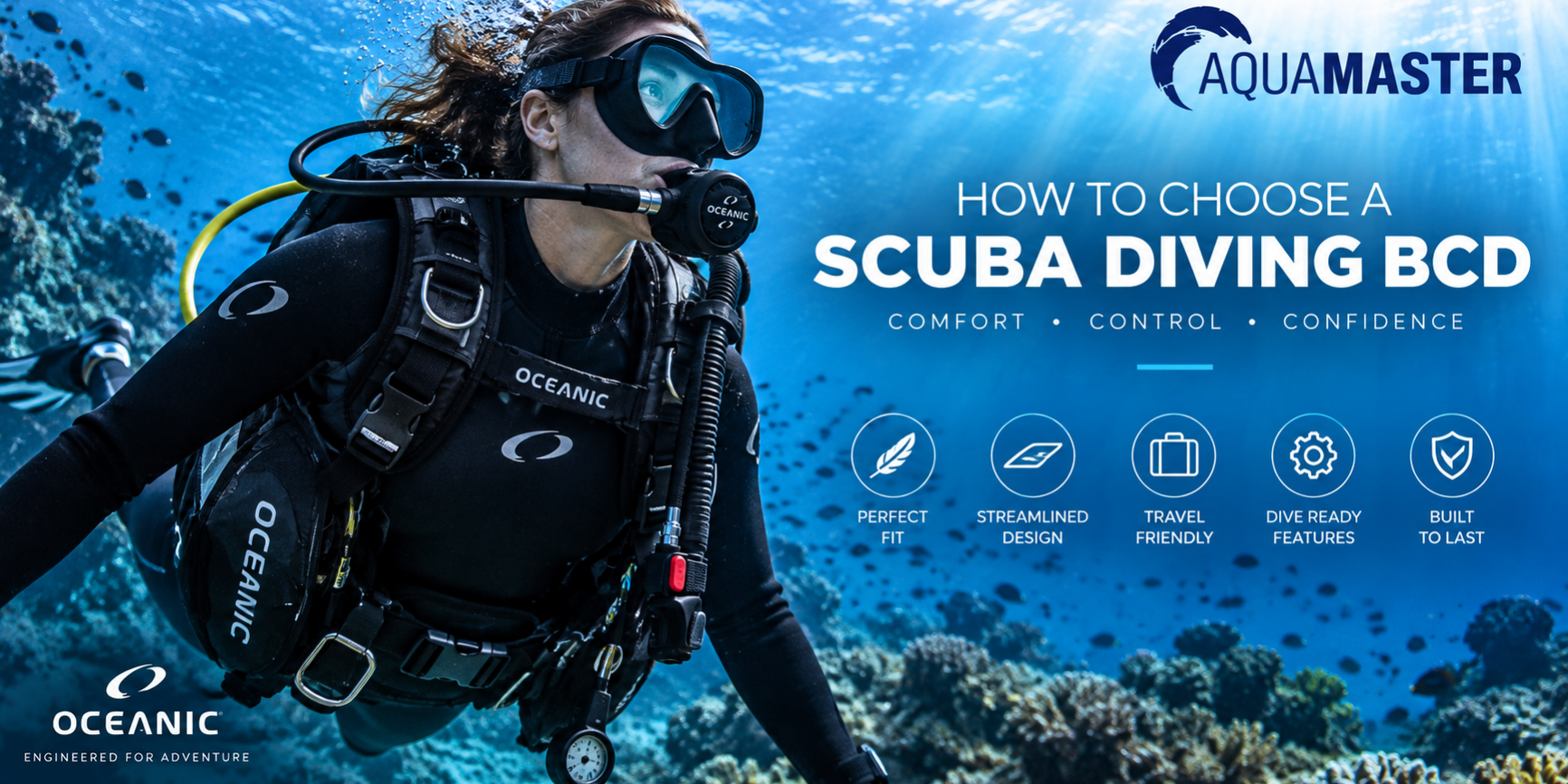
The Oceanic Photon range is an example of a modern back-inflation BCD designed for recreational divers looking for a streamlined configuration.
Jacket BCD vs Back-Inflate BCD
This is one of the most common questions when buying a BCD.
Neither design is automatically better for every diver.
Choose a jacket BCD if you prioritise:
- Familiar recreational configuration
- Comfortable surface flotation
- Storage
- Straightforward adjustment
- Training and general recreational use
Consider a back-inflate BCD if you prioritise:
- Freedom around the torso
- Streamlining
- Horizontal underwater positioning
- A less restrictive feeling around the chest
- Progression toward more modular equipment configurations
The most important consideration remains fit and comfort.
A correctly fitted jacket BCD is a better choice than a poorly fitted back-inflate model simply because one design is considered more advanced.
What Is a Backplate and Wing BCD?
A backplate-and-wing system separates the BCD into modular components.
A typical system consists of:
Backplate → provides structure
Harness → secures the system to the diver
Wing → provides buoyancy
Tank attachment system → secures the cylinder or cylinders
Unlike a conventional recreational BCD, individual components can often be replaced or changed independently.
This makes backplate-and-wing systems highly configurable.
They are particularly popular with:
- Technical divers
- Experienced recreational divers
- Twinset divers
- Divers who want modular equipment
- Divers who want to customise their harness and buoyancy system
Brands such as Hollis and Tecline offer modular systems that can be configured for different diving requirements.
→ Explore Technical & Wing BCD Systems
What Is a Travel BCD?
For divers who frequently fly to dive destinations, equipment weight can become important.
A travel BCD is designed to reduce weight and packing volume while maintaining the essential functionality of a conventional BCD.
Travel models may use:
- Lightweight materials
- Compact bladders
- Reduced padding
- Flexible or lightweight back supports
- Simplified pockets and hardware
A lighter BCD can make a significant difference when airlines impose strict baggage allowances.
However, don’t choose a BCD based only on its weight.
Consider whether the lighter design still provides the fit, lift, durability, storage and features you need.
For divers living in or travelling around Southeast Asia, where warm-water diving is common, a lightweight travel BCD can be a particularly practical choice.
What About Sidemount BCDs?
A sidemount BCD is designed for a completely different cylinder configuration.
Instead of carrying one or more cylinders on the diver’s back, sidemount divers position cylinders along the sides of the body.
The harness, bladder and attachment points are therefore designed specifically for sidemount diving.
Sidemount systems are used in technical diving, cave diving and increasingly by recreational divers who appreciate their flexibility and streamlined configuration.
If you intend to dive sidemount, choose a dedicated sidemount system rather than trying to adapt a conventional recreational BCD.
Hollis and Tecline both offer equipment designed specifically for sidemount configurations.
How Should a Scuba Diving BCD Fit?
Fit is one of the most important considerations when buying a BCD.
A correctly fitted BCD should remain secure on your body without excessive movement, but it should not restrict your breathing or range of motion.
When trying one on:
- Adjust the shoulder straps.
- Position and adjust the waist or cummerbund.
- Secure the chest strap if fitted.
- Check that the BCD remains stable.
- Make sure you can breathe deeply without restriction.
- Check that inflator and dump controls are easy to reach.
- Confirm that pockets and releases remain accessible.
Ideally, try the BCD while wearing approximately the same exposure protection you normally use.
A BCD that fits perfectly over a T-shirt may feel different when worn over a thick wetsuit.
Men’s vs Women’s BCDs
Some manufacturers offer BCDs specifically designed around different body shapes.
A women’s BCD may incorporate differences in:
- Shoulder strap positioning
- Torso length
- Waist shaping
- Chest-strap position
- Padding
- Overall proportions
The Oceanic Photon, for example, is available in men’s and women’s configurations.
The objective isn’t simply to make the BCD smaller. It is to provide a harness geometry and fit designed around different body proportions.
However, individual fit remains more important than the label.
Choose whichever BCD fits your body securely and comfortably.
How Much BCD Lift Do You Need?
A BCD’s lift capacity indicates how much positive buoyancy the bladder can provide when fully inflated.
More lift isn’t automatically better.
The amount you require depends on factors including:
- Cylinder type
- Exposure protection
- Amount of weight carried
- Single or multiple cylinders
- Fresh or salt water
- Overall equipment configuration
A recreational diver in warm Thai waters using a thin wetsuit and an aluminium cylinder generally has very different requirements from a cold-water technical diver carrying multiple cylinders.
Your BCD needs sufficient lift for the equipment configuration for which it is designed, without being unnecessarily oversized.
If you’re unsure, discuss your complete equipment configuration with an experienced dive professional before choosing the BCD solely from its maximum lift figure.
Integrated Weights or Weight Belt?
Many modern recreational BCDs include integrated weight pockets.
These allow some or all of the diver’s weight to be carried directly in the BCD rather than on a traditional weight belt.
Advantages can include:
- Greater comfort around the waist
- Convenient weight distribution
- Quick-release systems
- Reduced need for a separate weight belt
Some BCDs also include trim-weight pockets, usually positioned toward the rear, which can help distribute weight and improve underwater positioning.
A traditional weight belt remains a perfectly valid solution and may be preferable for certain divers or configurations.
Whichever system you use, you should understand how to release ditchable weights and practise the procedure as part of your training.
Why Trim Matters
Buoyancy and trim are related, but they are not the same thing.
Buoyancy determines whether you rise, sink or remain at a given depth.
Trim describes your body’s orientation in the water.
For efficient recreational diving, many divers aim for a relatively horizontal position. This can reduce drag, improve finning efficiency and help keep fins away from the bottom.
BCD design can influence trim, but so can:
- Cylinder position
- Weight placement
- Exposure protection
- Fins
- Body position
- Equipment configuration
Don’t expect a BCD alone to solve trim problems. Correct weighting and equipment configuration are equally important.
What BCD Features Should You Look For?
Once you’ve chosen the general style, compare the practical features.
Integrated Weight System
Useful if you prefer not to wear a separate weight belt. Check that the releases are secure, intuitive and easy to operate.
Trim Weight Pockets
Allow additional weight to be positioned toward the back of the BCD to help optimise weight distribution.
D-Rings
Useful for attaching accessories such as lights, gauges and other equipment.
Consider both the number and position of the D-rings rather than simply choosing the BCD with the most.
Storage Pockets
Large pockets can be useful for carrying items such as a surface marker buoy or accessories.
However, minimalist and travel BCDs may deliberately reduce storage to save weight and bulk.
Dump Valves
Multiple dump points can make it easier to release gas from different body positions.
You should know where your BCD’s dump valves are and how to operate them.
Inflator
The inflator should be intuitive, easy to reach and straightforward to operate while wearing gloves if you normally dive with them.
Cylinder Attachment
A stable cylinder attachment system helps prevent the tank from moving during the dive.
Materials and Durability
Dive-center equipment may prioritise durability and easy maintenance, while travel equipment may prioritise reduced weight.
There is always a balance between weight, durability, comfort and price.
BCDs for Dive Centers and Rental Fleets
Dive centers have different requirements from individual divers.
A rental BCD may be used hundreds of times by divers of different experience levels.
For rental and training applications, important considerations include:
- Durability
- Simple operation
- Easy size identification
- Easy adjustment
- Replaceable components
- Straightforward maintenance
- Availability of spare parts
- Cost of ownership
Complexity isn’t necessarily an advantage in a rental BCD.
For busy dive operations, a simple and robust jacket-style BCD can often be the most practical solution.
PSI ProDive and selected Oceanic models provide options suitable for dive centers, training and rental applications.
→ Explore BCDs for Dive Centers
Recreational vs Technical BCDs
A recreational BCD is normally designed around a relatively straightforward single-cylinder configuration.
Technical divers may require very different equipment.
A technical BCD system may need to accommodate:
- Twin cylinders
- Stage or decompression cylinders
- Greater lift requirements
- Backplates
- Modular harnesses
- Additional attachment points
- Redundant buoyancy strategies depending on the dive
Technical equipment should be selected according to the diver’s training, configuration and intended diving, not simply because it looks more advanced.
If you’re moving into technical diving, follow the equipment configuration recommended by your training and instructor.
How Much Should You Spend on a BCD?
Price should be considered alongside how frequently you dive and which features you genuinely need.
New Recreational Diver
Prioritise:
Fit → comfort → simple operation → durability
You don’t necessarily need the lightest or most technically sophisticated BCD.
Regular Recreational Diver
You may value:
Integrated weights → improved trim → better materials → back inflation → additional adjustment
Frequent Traveller
Consider:
Weight → packed size → drying time → sufficient lift → durability
Technical Diver
Your equipment choice will increasingly depend on:
Configuration → modularity → lift → harness → redundancy → training requirements
Buying the most expensive BCD doesn’t automatically give you the most appropriate system.
How Long Does a Scuba BCD Last?
A quality BCD can provide many years of service when properly maintained.
After diving, particularly in salt water:
- Rinse the exterior thoroughly with fresh water.
- Rinse the inside of the bladder according to the manufacturer’s instructions.
- Operate inflator and dump valves during rinsing.
- Allow the BCD to dry away from intense direct sunlight.
- Store it partially inflated if recommended by the manufacturer.
- Inspect straps, buckles, inflator and bladder regularly.
A BCD used intensively in a dive center will naturally experience more wear than privately owned equipment used a few times per year.
Replacement parts and local servicing availability are therefore worth considering when choosing a brand.
Looking for replacement components? → Explore BCD Accessories & Parts
Frequently Asked Questions About Scuba Diving BCDs
What is the best BCD for a beginner?
For most beginners, prioritise fit, comfort, easy controls and straightforward operation. A jacket-style BCD is a common choice, although a properly fitted back-inflate BCD can also be suitable for recreational divers.
Is a back-inflate BCD better than a jacket BCD?
Not necessarily. They provide different characteristics. Back-inflate designs provide greater freedom around the torso and can support a streamlined underwater position, while jacket BCDs offer familiar all-around buoyancy and are widely used for recreational diving.
Should a scuba BCD fit tightly?
A BCD should fit securely without excessive movement, but shouldn’t restrict breathing or movement. Remember to check the fit while wearing the exposure protection you normally dive in.
Do I need integrated weights?
No. Integrated weights are convenient but not essential. Divers can also use a traditional weight belt or other appropriate weighting system.
How much lift should my BCD have?
Required lift depends on your complete equipment configuration, exposure protection, cylinders and weighting. More lift isn’t automatically better, so choose a BCD appropriate for your actual diving.
Can I travel with a normal BCD?
Yes. However, frequent travellers may benefit from a lightweight travel BCD to reduce baggage weight and packing volume.
What is the difference between a BCD and a wing?
BCD is a general term for a buoyancy control device. A wing is a type of buoyancy bladder generally mounted behind the diver and commonly combined with a backplate and harness.
Can I use a technical wing for recreational diving?
Some backplate-and-wing systems can be configured for single-cylinder recreational diving. However, equipment should match your training, experience and intended configuration.
Find the Right BCD for Your Diving
There is no single BCD design that is right for every diver.
A new recreational diver may prefer the familiar comfort and simplicity of a jacket BCD, while another diver may prefer the freedom and streamlined configuration of a back-inflate BCD.
Frequent travellers may prioritise low weight and compact packing, while technical and sidemount divers require specialised systems designed around their equipment configurations.
Start with fit and comfort, then consider your diving style, lift requirements, weight system, travel needs and the features you will genuinely use.
Aquamaster offers scuba diving BCDs in Thailand from Oceanic, Hollis, Tecline and PSI ProDive, covering recreational, travel, rental and technical diving applications.
Not sure which BCD is right for you? Contact the Aquamaster team for help comparing BCD styles, sizing and features for your diving.